
Why Your AI Copy-Paste Habit is Making the Internet Worse (And What Melbourne Needs to Do About It)
Listen, I’ve seen it everywhere lately—especially in our local Facebook groups and community forums here in Brevard County. Someone asks a legitimate question about anything from hurricane prep to where to find the best fish tacos, and boom: an essay-length response appears within seconds that sounds like it was written by a very polite robot who’s never actually set foot in Melbourne, Florida.
You know the ones I’m talking about. They start with “Certainly!” or “As an AI language model…” Wait, no—scratch that. The really sneaky ones don’t even admit they’re AI-generated anymore. They just appear, suspiciously well-formatted, oddly formal, and completely devoid of that Florida weird we all know and love.
Here’s the thing: AI is getting really good at sounding smart. But it’s still putting seven fingers on people’s hands.
The Seven-Finger Problem We’re All Ignoring
That line about seven fingers? It’s not just a clever metaphor. If you’ve spent any time asking AI to generate images, you’ve seen it. Those eerily perfect faces with… wait, count those hands. One, two, three… seven fingers. Sometimes eight. Occasionally a thumb growing out of a wrist like some kind of evolutionary experiment gone wrong.
The same problem exists with text, except it’s harder to spot. AI doesn’t know that Melbourne, Florida isn’t Melbourne, Australia. It doesn’t know that nobody here calls it “Brevard County Beach” because we have actual names for our beaches (hello, Satellite Beach, Cocoa Beach, Indialantic). It confidently makes stuff up with the same authority it uses when it’s actually correct.
And when you copy-paste those responses without thinking? You’re spreading those seven-fingered facts all over the internet.
What This Looks Like in Real Life
I was scrolling through a local community board last week when someone asked about the best time to visit the Space Coast. The top response was clearly AI-generated—perfectly structured, grammatically flawless, and completely wrong about when we get our worst humidity. (Pro tip: it’s not “mild and pleasant in August.” That’s when you can practically swim through the air walking to your car.)
Here’s what I’m seeing across Melbourne and the Space Coast:
- Restaurant recommendations for places that closed three years ago
- Weather advice that sounds like it came from someone who’s never experienced a Florida summer
- Historical “facts” about our area that are just… creative fiction
- Local business info with wrong hours, wrong addresses, or wrong services
The scary part? These answers sound authoritative. They’re confident. They use big words. And they’re wrong.
Use Some Level of Thinking Skills First
Look, I’m not anti-AI. I use it. You probably use it. That’s fine. It’s a tool, like a hammer or a really sophisticated autocorrect. But you wouldn’t swing a hammer without looking at what you’re hitting, right?
The same logic applies here. Before you hit that copy-paste combo like you’re performing some kind of keyboard symphony, ask yourself:
Does this actually make sense? Does it sound like something a real person who lives here would say? Or does it sound like a textbook written by someone who learned about Florida from a Wikipedia article?
Can I verify this? If the AI is giving you “facts,” especially about local businesses, events, or statistics, take thirty seconds to confirm. Your reputation is worth more than the time you’ll save.
Am I adding value or just adding noise? The internet doesn’t need more content. It needs better content. If your AI-generated response doesn’t add something useful, original, or at least accurate, maybe just skip it.
The Irony of Using AI to Fact-Check Actual Humans
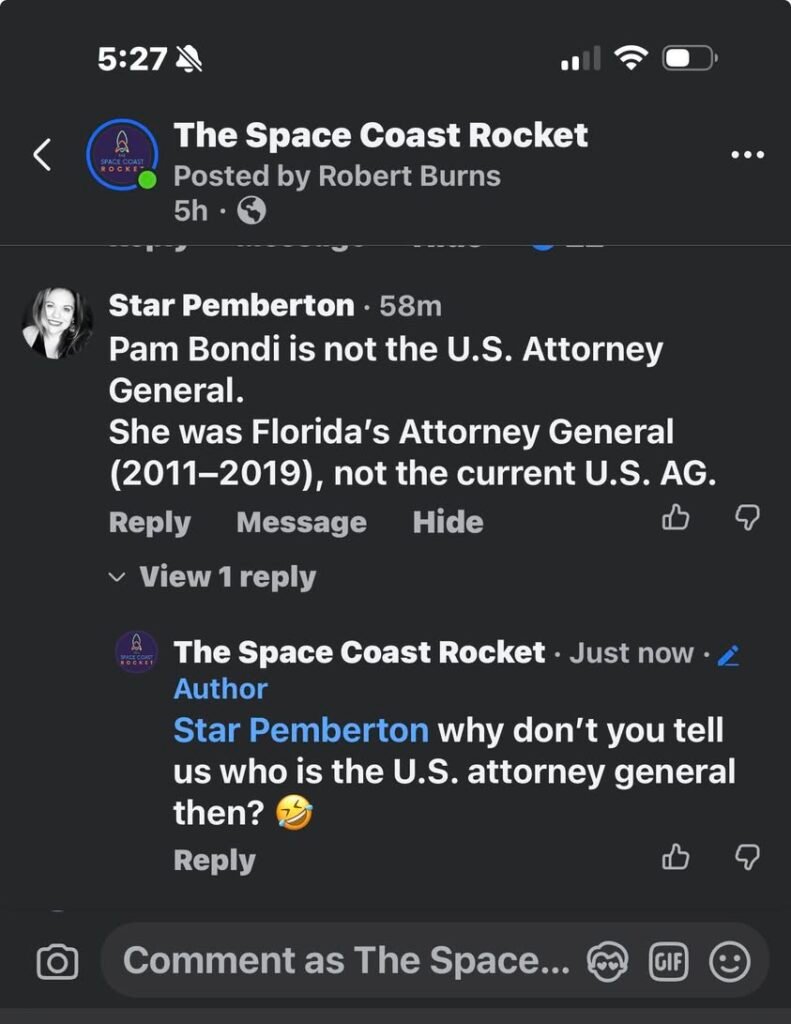
Here’s where it gets really wild: people using AI to fact-check real human experts. I’ve watched it happen in real time on local business pages. Someone with actual expertise shares knowledge from years of experience, and along comes Captain Copy-Paste with their AI-generated “correction” that’s confidently incorrect.
| Human Expert Says… | AI Copy-Paster “Corrects” With… |
|---|---|
| Real experience from working in the field | Generic information that sounds good but misses local context |
| Nuanced understanding of local conditions | One-size-fits-all advice that might work in Nebraska but not Florida |
| Actual knowledge of what’s happening right now | Outdated information from AI’s training data |
It’s like watching someone use their phone’s calculator to correct a mathematician. Sure, the calculator is useful, but maybe trust the person who actually understands the math?
How to Actually Use AI Without Looking Like a Robot
Okay, enough complaining. Let’s talk solutions. Because AI can be useful—you just need to use your brain alongside it.
The Double-Check Method
If you’re going to use AI for research or information, treat it like you would a enthusiastic intern: helpful, but needs supervision. Get the AI response, then verify it through actual sources. Local business question? Call them. Historical fact? Check with the Brevard County Historical Commission. Weather patterns? Look at actual meteorological data, not what an AI thinks sounds reasonable.
The Humanity Test
Before posting that AI-generated response, read it out loud. Does it sound like you? Does it sound like something a real person would say? If it sounds like a corporate press release or a term paper, rewrite it in your own words. Add your personality. Throw in a joke. Make it human.
The Local Knowledge Filter
Here in Melbourne and across Brevard County, we have specific things that only locals would know. The AI doesn’t know about the space shuttle era nostalgia that runs deep here. It doesn’t understand our relationship with NASA and SpaceX. It can’t tell you which beach has the best waves this time of year or where the locals actually eat (hint: it’s probably not the tourist traps on A1A).
If your AI response doesn’t pass the “would a local actually say this?” test, it needs work.
What This Means for Our Community
I care about this because I care about our community. When our local online spaces get flooded with AI-generated noise, we lose something valuable: authentic human connection and reliable local knowledge.
Think about it. Someone new moves to Melbourne and joins Facebook groups to learn about the area. If half the responses they get are copy-pasted AI garbage with seven-fingered facts,